
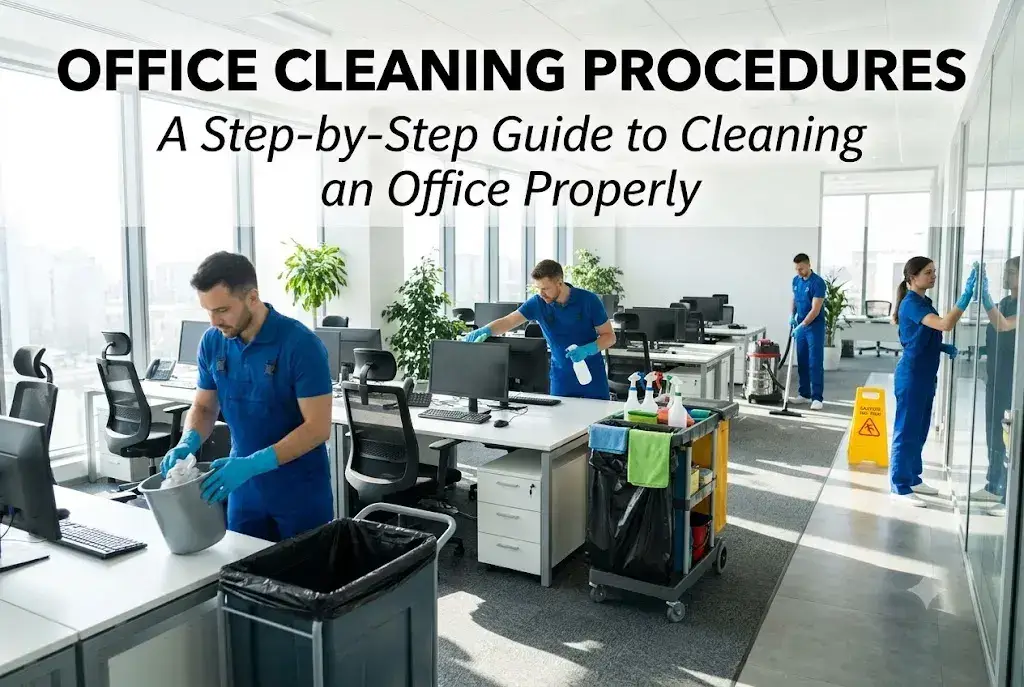
Office Cleaning Procedures: A Step-by-Step Guide to Cleaning an Office Properly
Most office cleaning problems aren’t caused by missed tasks. They’re caused by tasks done in the wrong order or with the wrong method: dusting after the floors are mopped, wiping a desk with the same cloth used in the washroom, or spraying disinfectant and wiping it off straight away. It looks like cleaning, but it doesn’t do the job.
Quick answer: Office cleaning procedures are the step-by-step methods used to clean a workplace consistently. The standard order is to prepare supplies, empty the trash, dust from high to low, clean surfaces with detergent, disinfect high-touch points for the full contact time, clean the break room and washrooms, finish with floors, then inspect the result.
This guide covers the how. If you need the what, our office cleaning checklist guide lists tasks by zone and frequency, and our office cleaning schedule template covers the when and who. Put simply: the checklist tells you what to clean, the schedule tells you when, and the procedure tells you how to do it properly.
What Are Office Cleaning Procedures?
Office cleaning procedures are written, repeatable methods for carrying out each cleaning task: which product to use, what order to work in, how long a product stays on a surface, and how the finished work is checked. They matter because two people can follow the same list of tasks and get very different results. A documented procedure removes that variation, which helps when staff rotate, a new cleaner starts, or the work moves to an outside team.
A good procedure answers four questions for every task:
- Which tools and products are used?
- In what order is the work done?
- How long does the product need to stay on the surface?
- How is the finished work checked?
The Standard Order of Work for Cleaning an Office
Whatever the size of the space, professional cleaners generally follow the same logic: work from high to low, from dry to wet, and from the cleanest areas to the dirtiest. Here is that logic as a step-by-step office cleaning procedure.
- Prepare supplies and the area. Gather everything before you start so you are not walking back and forth. Put out wet-floor signs where needed and clear obvious rubbish from surfaces without moving personal papers.
- Empty trash and recycling. Collect bins first, replace liners, and wipe the inside of any bin that looks soiled.
- Dust from high to low. Dry-dust shelves, partitions, reachable vents and monitors before any wet work starts, so dust does not fall onto surfaces you have already cleaned. Microfibre tends to trap dust better than a dry feather duster, which can push it back into the air.
- Clean surfaces with detergent. Desks, tables, counters and handles come next. The goal at this stage is to remove visible dirt and grease.
- Disinfect high-touch points. Door handles, light switches, shared phones, printer buttons and meeting-room remotes get a disinfectant that stays wet for the contact time on its label.
- Clean the break room. Clear and wipe counters, then clean sinks, appliance handles and tables.
- Clean the washrooms. Washrooms come after other areas, using their own cloths and mop, so germs are not carried back into work areas.
- Finish with floors. Vacuum or dust-mop first, then damp-mop hard floors, working backwards towards the exit so you never walk on a wet floor.
- Inspect, restock and sign off. Check the work, refill soap and paper products, and record the visit.
Cleaning vs. Disinfecting: Why the Order Matters
These are two different steps, and mixing them up is one of the most common mistakes in office cleaning. Cleaning removes dirt, grease and some germs using detergent and water. Disinfecting uses a chemical to kill germs that remain on a surface. Canadian public health guidance says surfaces should be cleaned before they are disinfected, because dirt and organic matter can stop a disinfectant from working properly.
Step | What it does | Procedure tip |
|---|---|---|
Clean | Removes dirt, grease and some germs | Use detergent and a clean cloth. Switch to a fresh cloth or a fresh side when it gets dirty. |
Disinfect | Kills germs left on a clean surface | Use a product with a Health Canada DIN and keep the surface wet for the full contact time. |
Sanitize | Reduces germs on food-contact surfaces | Follow the label. Food-contact surfaces may need a rinse afterwards. |
Three label checks before using any disinfectant
- DIN: an 8-digit Drug Identification Number from Health Canada confirms the product is approved for use as a disinfectant in Canada.
- Contact time: the length of time the surface must stay visibly wet. It varies by product, from about a minute to ten minutes, so check each label rather than assuming.
- Directions for use: the label tells you how to dilute the product, which surfaces it suits, whether it needs a rinse, and whether it is a one-step cleaner-disinfectant or needs a separate cleaning step first.
Wiping a disinfectant away before the contact time is up is a common way to waste it.
Office Cleaning Procedures by Area
Reception and Shared Areas
Start with glass doors and entry glass, then handles, seating and the reception desk. Vacuum mats and entrance floors last in this zone, since that is where grit comes in.
Workstations and Shared Desks
Work around personal items rather than moving them, and never read or rearrange documents. Apply product to the cloth instead of spraying directly onto keyboards, phones or screens, and check the device maker’s guidance for screens.
Meeting Rooms
Wipe tables, chair arms, remotes and conference phones, then clean glass partitions from top to bottom.
Break Rooms and Kitchens
Clear and wipe counters before disinfecting. Clean the sink and tap handles, the microwave interior, and fridge and appliance handles. Where a surface touches food, follow the label for sanitizing and rinsing.
Washrooms
Apply disinfectant to toilets, urinals and sinks first so the product starts its contact time while you clean mirrors and other surfaces. Finish with the floor. Use cloths, gloves and a mop reserved for washrooms only.
Floors and Carpets
On hard floors, dust-mop or vacuum before damp-mopping and change the mop water when it turns cloudy. On carpet, vacuum in overlapping passes. Vacuuming removes dry soil but not embedded dirt or stains, which is where professional carpet and upholstery cleaning comes in. Our guide on how often to schedule carpet cleaning explains the timing.
How to Prevent Cross-Contamination
Cross-contamination happens when germs move from a dirty area to a clean one on a cloth, mop or glove. A few simple habits prevent most of it:
- Separate cloths and mops for washrooms, kitchens and general areas. Many cleaning teams use colour coding to make this easy. There is no single universal colour standard, so choose a system and apply it consistently.
- Fold cloths into quarters and move to a fresh side as each one gets dirty.
- Launder microfibre cloths and mop heads after use instead of rinsing and reusing them.
- Never put a used cloth back into the clean solution. It contaminates the whole bucket.
- Change gloves when moving from washrooms to other areas.
Chemical Safety and WHMIS: What BC Offices Should Know
Cleaning products count as hazardous materials in a workplace. In BC, employers must follow WHMIS (the Workplace Hazardous Materials Information System) where hazardous products are used or stored, and workers need to know how to handle them safely. Some household-quantity consumer products are partly exempt from WHMIS labelling, but employers are still responsible for making sure workers handle products safely. If you are unsure which rules apply to your workplace, check WorkSafeBC’s WHMIS resources.
For day-to-day procedures, that translates into a few firm rules:
- Read the label and safety data sheet (SDS) before using an unfamiliar product.
- Never mix cleaning products. Bleach combined with ammonia or acid-based cleaners can release toxic gases.
- Label every decanted bottle with a workplace label so nobody has to guess what is inside.
- Ventilate the area and wear the protective equipment the label calls for, such as gloves or eye protection.
Business-Hours vs. After-Hours Procedures
When the work happens changes how you do it. After-hours cleaning allows wet mopping and machine work without interrupting anyone, but it needs a clear lock-up routine: who holds keys, who sets the alarm, and which areas are off limits. A clean-desk policy also helps, because it lets cleaners wipe surfaces without handling sensitive papers.
During business hours, keep the work quiet and focused on washrooms, break rooms and high-touch surfaces, with wet-floor signs in place.
How to Check the Work: Quality Control and Records
- Walk the space after each visit. Looking at glass and hard surfaces from an angle shows streaks and missed spots straight away.
- Keep a simple sign-off log with the date, area and initials so gaps are easy to trace.
- Spot-check washrooms and high-touch points more often than low-risk areas.
If you outsource the work, write your procedures into the scope of work. Our guide to what a North Vancouver commercial cleaning contract should include shows how, and our post on red flags when vetting a cleaning company covers what to watch for before you sign.
When to Hand Your Cleaning Procedures to a Professional Team
Written procedures only help if someone follows them every visit. For washrooms, shared spaces and recurring deep cleaning, many offices bring in a commercial cleaning provider so the routine does not depend on who is free that week. If you are weighing that up, start with our guide on choosing a commercial cleaning company in North Vancouver and our breakdown of commercial cleaning costs in North Vancouver.
Some situations call for a different set of procedures entirely. Offices that have just been renovated need post-construction cleanup to deal with fine construction dust, glass beyond easy reach is better left to window cleaning professionals, and larger workspaces with a warehouse or industrial side are covered in our warehouse and industrial cleaning guide.
Frequently Asked Questions
What is the correct order to clean an office?
Work from high to low, dry to wet, and clean to dirty. In practice that means preparing supplies, emptying trash, dusting, cleaning surfaces, disinfecting high-touch points, cleaning the break room and washrooms, finishing with floors, and then inspecting the work.
Should you clean or disinfect first?
Clean first. Dirt and organic matter can reduce how well a disinfectant works, so surfaces should be cleaned before they are disinfected, unless the label says the product is a one-step cleaner-disinfectant.
How long should disinfectant stay on a surface?
For as long as the label’s contact time says, and the surface needs to stay wet the whole time. Contact times differ by product, from about a minute to ten minutes.
Why are washrooms cleaned last?
Washrooms carry the highest risk of spreading germs. Cleaning them last, with dedicated cloths and mops, stops those germs being carried back into work areas and break rooms.
Which cleaning products should never be mixed?
Never mix bleach with ammonia or acid-based cleaners, since this can release toxic gases. As a general rule, do not combine any cleaning products unless the label says it is safe.
Do office cleaners in BC need WHMIS training?
Employers must make sure workers who use or handle hazardous products understand how to do so safely, and WHMIS training is part of that. Check WorkSafeBC’s WHMIS resources for the requirements that apply to your workplace.
Make Your Office Cleaning Procedures Easier to Follow
A procedure is only as good as the consistency behind it. Yara Cleaning provides commercial cleaning across North Vancouver, Vancouver, Burnaby, Richmond, Coquitlam and surrounding communities, built around your office size and routine. Contact us for a quote based on your space.