

Commercial Cleaning Checklist: What's Actually Included in North Vancouver Service Contracts
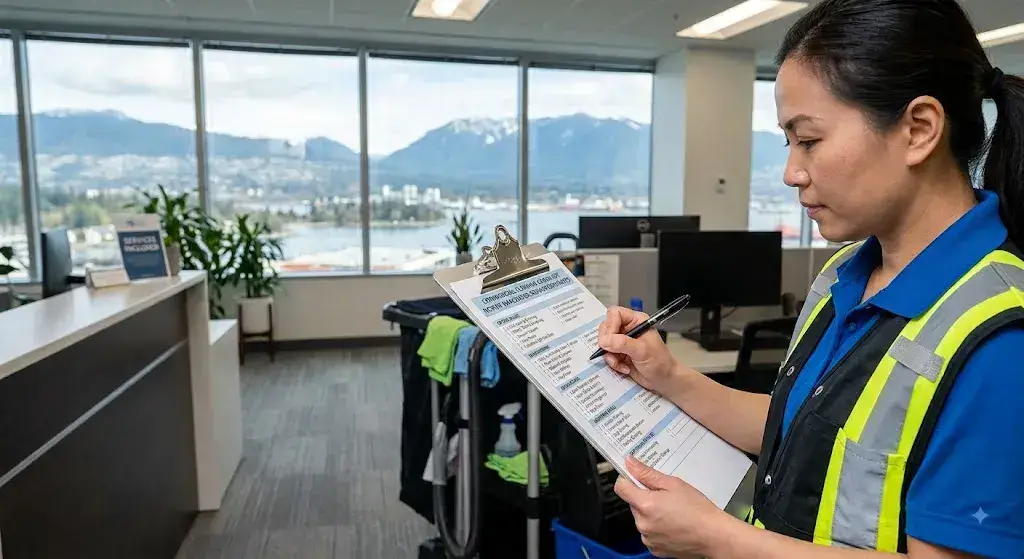
Most disputes between businesses and their cleaning company don’t start with bad cleaning — they start with an unclear contract. One side assumed windows were included; the other assumed they weren’t. A commercial cleaning checklist is what closes that gap: a written breakdown of exactly which tasks, areas, and frequencies your contract covers, so nothing is left to assumption.
Quick answer: A standard commercial cleaning contract in North Vancouver typically includes trash removal, vacuuming and mopping, washroom sanitation, dusting, and disinfection of high-touch surfaces at an agreed frequency. Carpet cleaning, window washing, floor stripping and waxing, and specialty disinfection are almost always billed as separate add-ons, not bundled into the base rate.
This guide breaks down what belongs in every section of a commercial cleaning contract — what’s standard, what’s an add-on, and what terms protect you if service falls short — so you can read a proposal with confidence instead of guessing.
What Is a Commercial Cleaning Checklist, Exactly?
A commercial cleaning checklist is the itemized list of tasks a cleaning provider commits to performing, organized by area and frequency. It’s different from a general office cleaning routine in one important way: a checklist tied to a contract is a commitment, not a suggestion. If a task isn’t on the checklist, it isn’t part of the service — no matter how “obvious” it might seem.
If you’re looking for the day-to-day task breakdown (what gets cleaned daily versus weekly versus monthly), our office cleaning checklist guide covers that in detail. This article focuses on the contract side: what a checklist needs to include to actually protect your business once you sign.
Why a Written Checklist Matters More in a Coastal Climate
North Vancouver’s wet season adds a layer most generic cleaning checklists don’t account for. Heavy fall and winter rain means entryways collect grit and moisture daily, carpets hold dampness longer, and window glass is more prone to streaking from condensation. A checklist that doesn’t adjust for this tends to under-deliver exactly when a building needs the most attention.
This is worth raising directly with any provider you’re evaluating: ask whether entryway and floor care frequency increases through the wetter months, or whether it’s the same fixed schedule year-round. A contract that flexes with the season is usually a sign the provider has actually serviced buildings in this climate before, rather than working from a generic template.
What’s Standard in Every North Vancouver Commercial Cleaning Contract
Regardless of provider, most base-rate commercial cleaning contracts in North Vancouver cover the same core scope of work:
Area | Standard Tasks Included |
Floors | Vacuuming carpets, sweeping and mopping hard floors |
Trash & Recycling | Emptying and relining bins throughout the space |
Washrooms | Cleaning and sanitizing toilets, sinks, and fixtures; restocking soap and paper products |
Surfaces | Dusting desks, shelves, and accessible furniture |
High-touch points | Disinfecting door handles, light switches, and elevator buttons |
Break rooms | Wiping counters, sinks, and tables |
This is the baseline you should expect quoted into any per-square-foot, hourly, or flat monthly rate. For a full breakdown of how these tasks are typically priced in this market, see our commercial cleaning cost guide for North Vancouver.
What’s Usually Billed as an Add-On (Not in the Base Contract)
This is where most confusion happens. The following services are commonly assumed to be “part of cleaning” but are almost always quoted separately:
- Carpet and upholstery cleaning — deep extraction or steam cleaning, typically scheduled quarterly or semi-annually rather than included in routine visits
- Window cleaning — interior and exterior glass, especially for storefronts and multi-floor buildings
- Floor stripping and waxing — a specialized service for hard flooring, usually billed per project
- High-touch or medical-grade disinfection — beyond standard sanitizing, required for clinics and healthcare-adjacent spaces
- Post-construction or post-renovation cleanup — a one-time deep clean after building work, distinct from ongoing service
If your business needs any of these regularly, it’s worth asking your provider to bundle them into a flat monthly rate rather than paying per visit. Our commercial cleaning services page outlines how these add-ons fit alongside a standard contract, and our carpet and upholstery cleaning and window cleaning pages break down each service individually.
Frequency and Scheduling Terms Your Contract Should Define
A checklist without a frequency attached is close to meaningless. Every task should specify how often it happens — daily, weekly, monthly, or quarterly — and your contract should spell this out rather than leaving it as a verbal understanding.
Most North Vancouver commercial contracts also address:
- Time of service — many businesses schedule cleaning after hours or on weekends to avoid disrupting operations, which can carry a modest premium, generally in the 10–20% range
- Holiday and closure adjustments — how service is handled around statutory holidays or building closures
- Seasonal scheduling changes — North Vancouver’s wet season increases entryway grit and moisture, which is why some contracts build in more frequent floor attention through the fall and winter months
Scope of Work: Which Areas Are Actually Covered
A clear scope of work section defines the physical boundaries of the contract — not just the tasks. This matters more than it sounds like it should, especially in shared or strata-managed buildings.
Your contract should specify whether service covers:
- Your tenant space only, versus shared building common areas
- Reception, boardrooms, and private offices individually
- Break rooms and kitchen areas
- Washrooms — private to your suite, or shared with other tenants
- Storage rooms, server rooms, or restricted-access areas
In multi-tenant or strata buildings, it’s common for common-area cleaning (lobbies, elevators, shared hallways) to be billed under a separate strata contract entirely, which is worth confirming so you’re not paying twice — or assuming coverage that doesn’t exist.
Service Level Agreement (SLA) and Quality Standards
Many commercial cleaning contracts include a service level agreement, which defines what “done well” actually means and what happens if it isn’t. A solid SLA typically covers:
- Specific, measurable standards rather than vague language like “quality cleaning”
- A process for reporting a missed or unsatisfactory task
- The remedy — a redo visit, a service credit, or another resolution
- Response time expectations for issues raised
Without an SLA, you’re relying entirely on goodwill if a visit falls short. With one, you have something to point to.
Insurance, Bonding, and Liability Coverage
Every legitimate commercial cleaning contract in BC should confirm the provider carries general liability insurance and WorkSafeBC coverage, and should offer to provide proof on request — something property managers and strata councils often require before approving a vendor. This protects your business if a cleaner is injured on-site or if property is damaged during service. If a provider hesitates to share this documentation, that’s worth treating as a warning sign rather than an oversight.
Access, Security, and Key or Fob Management
Commercial cleaning almost always happens when your team isn’t around, which means your contract needs to address building access clearly:
- How keys, fobs, or alarm codes are issued and tracked
- What happens if a key or fob is lost
- Background check policies for cleaning staff
- Sign-in or sign-out logging for buildings with security requirements
This section is easy to skip in a proposal but matters a lot in practice — especially for medical offices, law offices, or any space handling sensitive information.
Pricing and Payment Terms
Your contract should clearly state which pricing model applies — per square foot, per hour, or flat monthly — along with payment terms, invoicing frequency, and how add-on services are billed when requested outside the regular schedule. For a full breakdown of typical rates by business type and pricing model, see our commercial cleaning cost guide.
Reporting, Issue Resolution, and Communication
A good contract names an actual process for flagging problems: who to contact, how quickly they’ll respond, and what recourse exists if the same issue repeats. Some providers use a digital checklist or supervisor walkthrough system so quality control isn’t just self-reported by the cleaning crew — a detail worth asking about directly.
Contract Length, Termination, and Renewal Terms
Commercial cleaning contracts are usually structured month-to-month or as a fixed annual term with renewal built in. Either way, your contract should specify:
- The notice period required to cancel or modify service
- Whether pricing is locked for the contract term or subject to review
- How service changes (added square footage, new frequency) are handled mid-contract
Missing any of these tends to be where disputes surface later, usually at the least convenient time.
Red Flags to Watch for Before Signing
A few signs suggest a contract needs more detail before you sign it:
- Vague language like “thorough cleaning” or “as needed” instead of itemized tasks
- No mention of insurance or bonding
- No defined process for reporting a missed task
- Pricing that isn’t broken down by service
- Reluctance to provide references from other commercial clients
It’s also worth asking how the provider handles quality control internally — whether that’s a supervisor walkthrough, a digital checklist signed off after each visit, or a follow-up call. A provider with no internal check on their own crew is relying entirely on the crew’s own reporting, which isn’t much of a safeguard if something gets missed.
If you’re comparing multiple proposals, our guide on choosing a commercial cleaning company in North Vancouver walks through the full vetting process, including the questions worth asking before you commit.
Frequently Asked Questions
What is typically included in a commercial cleaning contract?
A standard contract includes trash removal, vacuuming and mopping, washroom sanitation, dusting, and disinfection of high-touch surfaces at an agreed frequency, along with defined scope of work, insurance details, and payment terms.
What’s usually not included in a standard commercial cleaning checklist?
Carpet cleaning, window washing, floor stripping and waxing, and specialty or medical-grade disinfection are typically quoted as add-ons rather than bundled into base service.
How often should commercial cleaners come to a North Vancouver office?
It depends on foot traffic: high-traffic spaces like retail and medical offices often need daily service, while standard offices with lighter traffic commonly do well with two to three visits per week.
What should I ask before signing a commercial cleaning contract?
Ask what’s included in the base rate versus billed as an add-on, whether the provider is insured and bonded, how missed tasks are reported and resolved, and what the notice period is for cancelling or changing service.
Does a commercial cleaning contract cover common areas in a shared building?
Not always. In multi-tenant or strata buildings, common-area cleaning is often billed under a separate contract, so it’s worth confirming exactly which spaces your agreement covers.
Get a Clear, Itemized Commercial Cleaning Checklist for Your Space
The best way to avoid contract confusion is to start with a provider who itemizes the scope of work before you sign — not after something gets missed. Yara Cleaning provides commercial cleaning across North Vancouver with a clearly defined checklist, transparent pricing, and full insurance coverage for every contract.
Contact us for a walkthrough assessment and a written, itemized proposal for your business.