

Office Cleaning Schedule: How to Build One That Actually Holds Up (Daily, Weekly & Monthly Template)
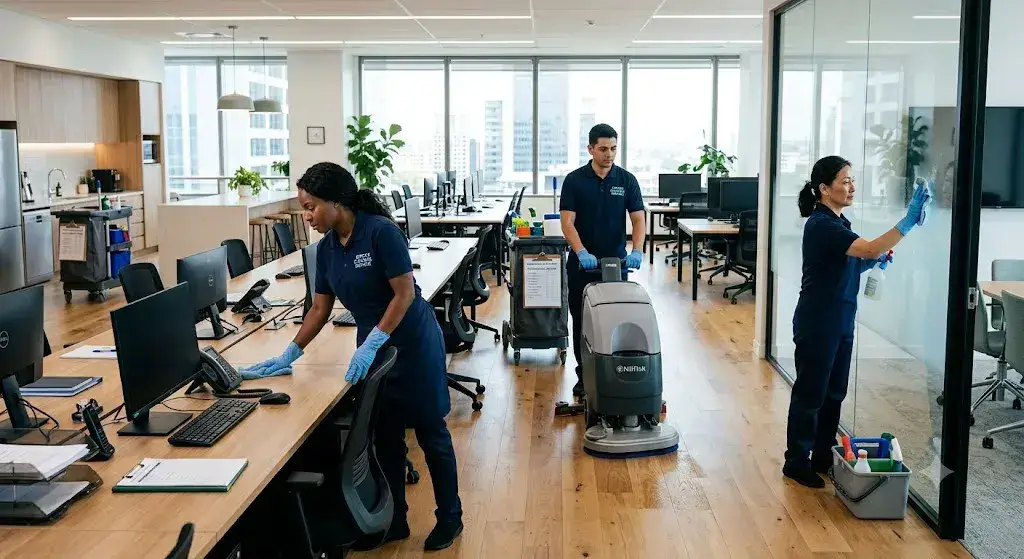
Most offices don’t have a cleaning problem — they have a scheduling problem. The tasks everyone agrees need doing (wiping desks, disinfecting washrooms, vacuuming) still get skipped, not because nobody cares, but because no one ever wrote down when they happen and who’s responsible. An office cleaning schedule fixes that by turning cleaning from a vague expectation into a fixed routine tied to specific days, frequencies, and people.
Quick answer: An office cleaning schedule assigns cleaning tasks to specific days and frequencies — daily, weekly, and monthly — and names who’s responsible for each one. Most offices clean high-touch areas and washrooms daily, do deeper tasks like vacuuming upholstery and disinfecting shared equipment weekly, and reserve carpet care, window cleaning, and vent dusting for monthly or quarterly rotations.
This guide focuses on the scheduling side: how to structure your week, how many cleaning days your office actually needs, and how to build a rotation your team (or your commercial cleaning provider) can follow without it falling apart by week three. If you’re looking for the full task-by-task breakdown of what to clean at each frequency, our office cleaning checklist guide covers that in detail — this article is the companion piece that covers when and who.
Office Cleaning Schedule vs. Office Cleaning Checklist: What’s the Difference?
The two get used interchangeably, but they solve different problems.
- A checklist lists the tasks — wipe down desks, disinfect door handles, empty bins.
- A schedule assigns those tasks to a timeline — which days, how often, and who owns them.
You need both. A checklist without a schedule tells staff what to do but not when, so tasks drift to “whenever there’s time,” which usually means never. A schedule without a checklist tells people when to clean but leaves the actual scope open to interpretation. Most office cleaning problems trace back to having one without the other.
How to Build an Office Cleaning Schedule in 5 Steps
- List your zones. Break the office into areas — reception, workstations, break room, washrooms, conference rooms, and any shared equipment areas like printer stations.
- Set a frequency for each task. Decide what genuinely needs daily attention versus what can wait a week or a month. High-touch, high-traffic areas go daily; deeper maintenance tasks go weekly or monthly.
- Assign an office cleaning day (or days). Fixed days work better than “sometime this week.” If washrooms are cleaned every Monday, Wednesday, and Friday, everyone — staff, cleaners, and managers — knows exactly what to expect.
- Name an owner for each task. A schedule with no accountability is just a wish list. Whether it’s a rotating staff duty or a professional cleaning crew, every task needs a name attached to it.
- Review and adjust quarterly. Office layouts, headcounts, and seasons change. A schedule built in January may need more frequent floor care by November, once the rain sets in.
Sample Weekly Office Cleaning Schedule
Here’s a practical weekly office cleaning schedule you can adapt to your own space. It spreads tasks across the week instead of stacking everything into one long session, which is where most DIY schedules break down.
Day | Focus | Key Tasks |
Monday | Reset after the weekend | Empty bins, disinfect washrooms and high-touch points, vacuum high-traffic areas |
Tuesday | Break room & kitchen | Sanitize counters and sinks, wipe appliance handles, clean out the fridge |
Wednesday | Workstations | Disinfect shared desks and phones, dust accessible surfaces, mop hard floors |
Thursday | Meeting spaces | Wipe down conference tables and AV equipment, clean glass partitions |
Friday | Weekly deep pass | Vacuum upholstery, wipe baseboards and window sills, restock washroom supplies for the week ahead |
Saturday/Sunday | Off (or light touch-up) | Trash removal only, if the space is used on weekends |
Daily tasks — bins, washroom sanitation, high-touch disinfection — happen every single office cleaning day regardless of what else is scheduled. The table above just shows how the additional weekly tasks can be spread out so no single day carries the full load.
Monthly and Quarterly Rotation
Some tasks don’t belong on a weekly schedule at all — they’re too resource-intensive to do that often and don’t need to be. Build these into a monthly or quarterly rotation instead:
- Deep-clean carpets and upholstered furniture
- Interior and exterior window cleaning
- High-dusting vents, light fixtures, and ceiling corners
- Machine-scrubbing and polishing hard floors
For the full task list at each of these frequencies, see our office cleaning checklist guide, which breaks daily, weekly, and monthly tasks down by zone.
How Many Days a Week Should an Office Be Cleaned?
This is the most common question behind every office cleaning schedule search, and the honest answer is: it depends on foot traffic and headcount, not a fixed rule.
- Small offices (under 20 people): 2–3 cleaning days per week is usually enough, provided staff handle light daily upkeep like trash and desk wiping between visits.
- Mid-size offices (20–100 people): Daily cleaning, especially for washrooms, break rooms, and reception, is generally necessary to keep pace with use.
- Large offices (100+ people or multiple floors): These need a daily schedule at minimum, often with washroom touch-ups scheduled more than once a day and a dedicated monthly deep-clean rotation layered on top.
If you’re unsure which tier your office falls into, our guide on commercial cleaning cost in North Vancouver breaks down typical cleaning frequency and pricing by office size, which is a useful cross-check once you’ve drafted a schedule.
Assigning Ownership: In-House Rotation vs. a Professional Schedule
Once your schedule is built, someone has to actually run it. There are two common models:
In-house staff rotation works when the office is small, tasks are light, and someone is willing to own the schedule long-term. The risk is consistency — rotations fall apart during busy weeks, vacations, or staff turnover, and washrooms are usually the first thing to slip.
A professional cleaning schedule removes that risk. A commercial cleaning provider works from a fixed, contracted schedule that doesn’t depend on whether your team is busy that week. This is especially worth considering for washrooms and shared spaces, which carry the highest risk of germ spread and are the hardest area to maintain consistently through informal staff rotation.
Most offices land somewhere in between: light daily upkeep handled internally, with a professional team covering the fixed schedule for washrooms, floors, and monthly deep-cleaning. If you’re comparing providers, our guide on choosing a commercial cleaning company in North Vancouver walks through what to ask before signing, and our commercial cleaning checklist for North Van contracts shows what a written scope of work should actually include once you hand the schedule over.
Adjusting Your Office Cleaning Schedule for North Vancouver’s Climate
A schedule built from a generic template rarely accounts for what the Lower Mainland’s weather actually does to an office. A few adjustments are worth building in from the start:
- Entryway attention increases in fall and winter. Rain means mud and grit get tracked in constantly. Offices in North Vancouver, West Vancouver, and along the North Shore often need entry mats and lobby floors checked daily through the wet season, not just on the standard rotation.
- Window cleaning may need to move up the calendar. Condensation between heated interiors and damp exteriors causes streaking faster here than in drier climates, so a quarterly window schedule sometimes needs to shift to monthly during peak rainy months.
- Carpet care can’t wait the full month. Damp foot traffic means carpets hold moisture longer, which raises the risk of odor if deep cleaning is pushed too far out on the schedule.
None of this means rebuilding your entire schedule — it usually just means shortening the interval on two or three tasks during the wetter months and returning to the standard rotation in summer.
Common Office Cleaning Schedule Mistakes
- No fixed office cleaning day. “Sometime this week” isn’t a schedule — it’s a suggestion, and it’s the first thing that gets dropped during a busy stretch.
- Treating every task the same frequency. Daily tasks and monthly tasks stacked into one undifferentiated list overwhelm whoever owns the schedule and nothing gets prioritized properly.
- No named owner. A schedule with tasks but no assigned person defaults to “someone will probably do it,” which is exactly the problem a schedule is supposed to solve.
- Never adjusting for seasons or headcount. A schedule that worked for a 15-person office doesn’t hold up once you’re at 40, and a schedule built in summer often under-serves an office through a Vancouver winter.
- No review process. Schedules should be revisited every quarter, not set once and forgotten.
Frequently Asked Questions
What is an office cleaning schedule?
An office cleaning schedule assigns specific cleaning tasks to fixed days and frequencies — daily, weekly, and monthly — and names who’s responsible for completing each one, so cleaning happens consistently rather than whenever there’s time.
How often should an office be cleaned?
Most offices need daily attention for washrooms, high-touch surfaces, and trash removal, weekly attention for deeper tasks like vacuuming upholstery and disinfecting shared equipment, and monthly attention for carpets, windows, and vents. Exact frequency depends on office size and foot traffic.
What’s the difference between an office cleaning schedule and a checklist?
A checklist lists what tasks need doing; a schedule assigns those tasks to specific days, frequencies, and people. A complete cleaning routine needs both.
How many days a week should an office be professionally cleaned?
Small offices often do well with 2–3 professional visits per week, mid-size offices typically need daily service for washrooms and shared areas, and large or multi-floor offices generally require daily cleaning with additional washroom touch-ups throughout the day.
Should my office cleaning schedule change with the seasons?
Yes, particularly in North Vancouver. Wet-season months typically call for more frequent entryway, floor, and window attention, since rain and humidity accelerate grime buildup compared to drier months.
Build a Schedule You Don’t Have to Chase
A written schedule only works if someone reliably follows it, week after week, without needing reminders. If you’d rather hand that consistency to a team that already runs on a fixed schedule, Yara Cleaning provides commercial cleaning across North Vancouver, Vancouver, Burnaby, Richmond, Coquitlam, and surrounding communities, built around your office size, industry, and cleaning days — not a generic template.
Contact us for a custom office cleaning schedule and quote for your space.