

How to Vet a Commercial Window Cleaning Contractor in North Vancouver
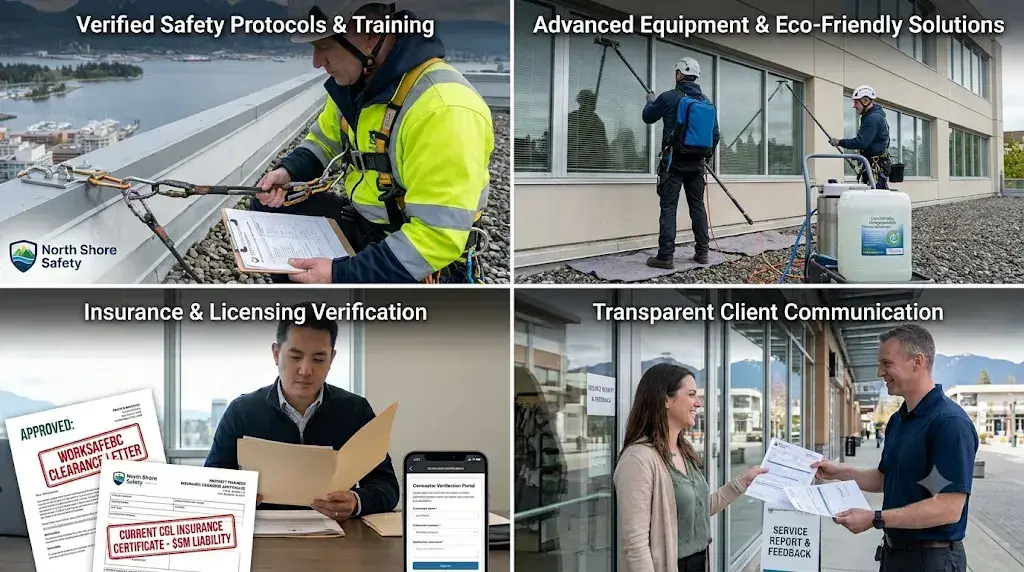
Hiring a commercial window cleaning contractor in North Vancouver is not like booking a cleaner for your home. The crew will work at height, beside your tenants and customers, on a building that you or your strata is responsible for. If something goes wrong, “they gave the lowest quote” will not satisfy an insurer, WorkSafeBC or your council.
This guide shows property managers, facilities managers, strata councils and business owners how to vet a contractor: the documents to request, the safety records that matter, the red flags to walk away from and the contract terms that protect you. It reflects North Shore conditions, from rainy winters and tree debris to hillside sites and mixed-use buildings along Lonsdale.
How Do You Vet a Commercial Window Cleaning Contractor?
To vet a commercial window cleaning contractor, verify five things before you sign: a current certificate of insurance naming you as additional insured, a WorkSafeBC clearance letter addressed to you, a written fall protection and access plan for your building, a valid business licence, and references from comparable properties. Then confirm scope, schedule and incident terms in writing.
Use this checklist when you request documents from each bidder:
Document | What it proves | Where to verify |
|---|---|---|
Certificate of insurance (COI) | Active liability cover and limits | Contractor’s insurance broker |
WorkSafeBC clearance letter | Registered and paying premiums | WorkSafeBC clearance application |
Fall protection plan | Safe access method for your building | Contractor, reviewed by you |
Equipment inspection logs | Ladders, poles and platforms checked | Contractor records |
Training records | Crew trained for height and WHMIS | Contractor records |
COR status (optional) | Audited safety management system | WorkSafeBC employer search |
Business licence | Legal to operate in your municipality | City or District of North Vancouver |
References | Track record on similar buildings | Call two or three clients |
Why Vetting Matters for Commercial Window Cleaning
Commercial window work carries risks that residential jobs rarely do: falls from height, falling objects, broken glass and the public walking below. It also raises a responsibility question. When workers from more than one employer share a site, WorkSafeBC treats it as a multiple-employer workplace, and the owner (which can include a property manager or tenant acting for the owner) is the default prime contractor unless a written agreement names someone else. WorkSafeBC explains these roles, and whether they apply to your building depends on the job, so confirm with WorkSafeBC or your advisor. Either way, a documented, verified contractor is your strongest protection.
Step 1: Verify Liability Insurance With a Certificate of Insurance
Never accept “we’re fully insured” as proof. Ask for a certificate of insurance (COI) sent directly from the contractor’s broker, and check four details:
- The named insured matches the contractor’s legal business name.
- Commercial general liability limits meet what your insurer or strata management requires. BC strata corporations must carry at least $2 million in liability cover themselves, and strata-industry guidance on hiring contractors suggests asking for at least $2 million, with $5 million ideal.
- Your company or strata corporation is listed as an additional insured.
- The policy dates cover the whole contract, with written notice of cancellation (30 days is a common request).
Taller or higher-risk buildings may warrant higher limits, so ask your broker what to require. Request a fresh COI at every renewal and file it with the contract.
Step 2: Check WorkSafeBC Registration and Request a Clearance Letter
A contractor’s liability policy typically does not cover injuries to its own workers. WorkSafeBC coverage does. A clearance letter confirms a contractor is registered and paying its premiums. If a contractor you hire fails to pay, you could be liable for the premiums on that work, which is why WorkSafeBC advises getting a letter before work begins and again before final payment.
Three details matter:
- The letter must be addressed to you for WorkSafeBC to honour it in your favour. A generic letter the contractor already holds does not do the job.
- It should read “active and in good standing” for the period of the contract.
- You can search any firm by name or account number in the WorkSafeBC clearance letter application.
Optional but telling: a Certificate of Recognition (COR) shows a contractor has built and audited a safety management system. COR is voluntary, so its absence is not a red flag, but its presence is a strong signal.
Step 3: Review Safety Records and Fall Protection Plans
Property managers often ask which Vancouver commercial window cleaning companies have good safety records. There is no public scoreboard, so you build the picture from documents. Ask every bidder for:
- A written fall protection and access plan for your building, consistent with WorkSafeBC’s Part 11 fall protection guidelines.
- Equipment inspection logs. WorkSafeBC requires ladders, window cleaner’s belts and work platforms to be inspected before use on each shift.
- Training records for working at height, chemical handling and WHMIS.
- Safe work procedures for wet weather, pedestrian control and glass breakage.
- A three-year incident summary and how each incident was handled.
If your roof has fixed anchors for suspended or rope access work, ask who inspected and certified them, and when. WorkSafeBC publishes a bulletin on using anchors in fall protection systems, and BC institutions such as UBC specify anchors that meet CSA Z91 for window cleaning access. A contractor who asks for those records before quoting is usually one who takes safety seriously.
Step 4: Match the Contractor to Your Building Type
A crew that excels at storefronts may not be equipped for a seven-storey building. Ask which access method each elevation needs and who will perform the work:
- Storefronts and low-rise offices: water-fed poles, ladders or lifts, usually handled by a small crew. Our commercial window cleaning in North Vancouver service covers this work.
- Strata and taller buildings: suspended or rope access work needs specialist training and certified anchors. For strata-specific planning, see our strata window cleaning guide.
- Renovation and new-build glass: paint, cement and sealant residue need careful removal with the right tools. See post-construction window cleaning in North Vancouver.
If a contractor plans to subcontract any part of the job, get that in writing. Your clearance letter and insurance certificate must cover whoever actually does the work.
Step 5: Confirm Licensing, References and Local Experience
Ask for the contractor’s business licence number. Eligible North Shore contractors can hold an inter-municipal business licence that allows work in the City of North Vancouver, the District of North Vancouver and West Vancouver, so confirm the licence covers your property’s municipality.
Then call two or three references with similar buildings. Ask whether the crew arrived on schedule, how damage or complaints were handled, and whether the final invoice matched the quote. Local experience matters too. North Shore buildings contend with heavy rain, tree debris, moss and mineral spotting, and a good contractor will explain how they schedule around the weather.
Step 6: Insist on a Site Walkthrough Before the Final Quote
Any quote given without seeing the property is a guess. A proper walkthrough lets the contractor identify access points, glass types and heights, roof anchors, hazards such as overhead wires or landscaping, tenant hours and the pedestrian routes that need barricades. It is also your chance to document existing scratches, cracked seals and damaged frames so there is no dispute later. Ask who will supervise the crew on the day, and whether that person is the one walking the site. For facilities window cleaning services, the walkthrough should end with a written scope that you can compare across bidders.
Step 7: Compare Quotes and Read the Contract
Compare quotes line by line, not by total. A reliable written quote lists the buildings and elevations covered, interior and exterior scope, frames, sills and tracks, access method, frequency and any exclusions. If you run a formal tender, send every bidder the same scope and document requirements so the bids compare fairly. Our commercial cleaning quote checklist and window cleaning cost guide show what fair pricing looks like.
A recurring window cleaning maintenance contract should spell out:
- Term, renewal and termination notice.
- Weather and rescheduling rules.
- Insurance and WorkSafeBC documents attached, with renewal dates.
- How damage claims and incidents are reported and resolved.
- Subcontracting disclosure and price-change terms.
Have a lawyer or your property manager review indemnity and limitation-of-liability clauses before signing. For scheduling and contract structure, see our commercial window washing schedule and contract guide.
Red Flags When Hiring a Commercial Window Cleaner
- Says “fully insured” but will not send a certificate.
- Cannot give a WorkSafeBC account number, or offers a clearance letter addressed to someone else.
- Has no written plan for work at height.
- Quotes far below every other bid with no scope detail.
- Asks for cash only or will not issue an invoice.
- Avoids references or reveals subcontractors only when pressed.
Our wider guide to red flags when vetting a cleaning company applies here too.
How Yara Cleaning Handles Commercial Window Cleaning
At Yara Cleaning, our window cleaning covers offices, retail fronts and commercial buildings, inside and out. We are fully insured and bonded, our teams are background-checked and WorkSafeBC compliant, and every job starts with an on-site walkthrough and a fixed-price quote with no hidden fees. Ask us for the same documents recommended in this guide. If you also need regular janitorial support, explore our commercial cleaning services in North Vancouver or read how to choose a commercial cleaning company in North Vancouver.
Frequently Asked Questions
What insurance should a commercial window cleaner carry in BC?
At minimum, commercial general liability insurance plus WorkSafeBC coverage for its workers. Limits depend on your building and insurer; strata guidance suggests at least $2 million, with $5 million ideal. Request a certificate naming you as additional insured.
How do I check that a window cleaner is registered with WorkSafeBC?
Search the firm by name or account number in WorkSafeBC’s clearance letter application, then request a letter addressed to you confirming it is active and in good standing. Ask again before final payment.
How often should commercial windows be cleaned?
It depends on foot traffic, nearby trees and how much appearance matters to your business. Storefronts are commonly cleaned weekly to monthly, and offices quarterly or twice a year. Our guide to how often to clean windows helps you choose.
Who is responsible if a window cleaner is injured on my property?
It depends on the contract, the contractor’s WorkSafeBC status and who is the prime contractor at your site. A verified clearance letter, a written agreement and proper insurance reduce your exposure. For your specific situation, speak with your insurer or a lawyer.
Final Checklist Before You Sign
The right contractor will hand over insurance, WorkSafeBC and safety documents without a fight. Verify each one, compare scopes rather than totals, and keep the paperwork on file with the contract. Ready to compare? Request a free commercial window cleaning quote from Yara Cleaning at (604) 442-1230 or contact us online.