

Office Cleaning Checklist: Daily, Weekly, and Monthly Tasks for a Healthier Workplace
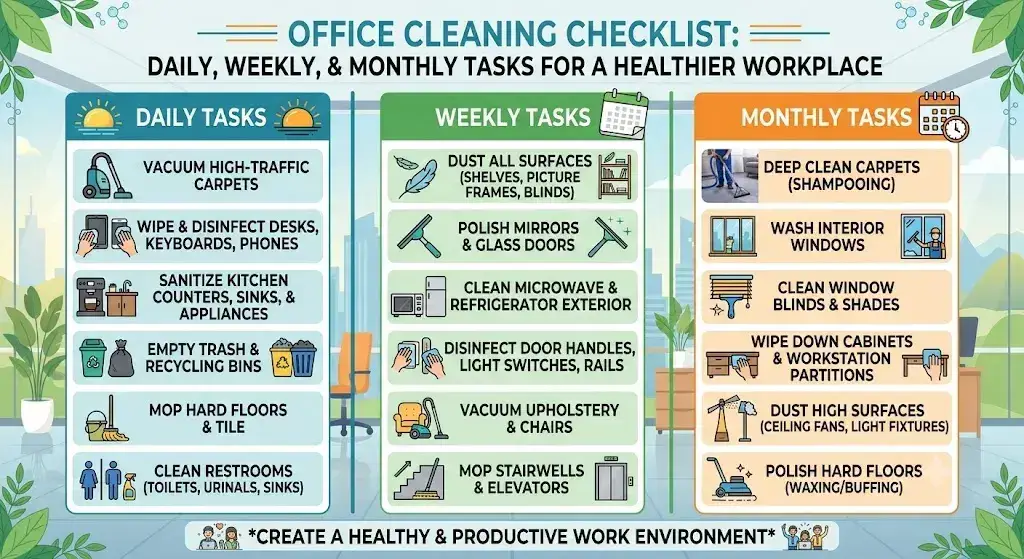
A commercial office desk can carry far more bacteria than most people assume, and without a routine in place, that bacteria only builds up as the day goes on. That’s the real argument for a written office cleaning checklist: it’s not about ticking boxes, it’s about making sure the tasks that actually protect employee health and the professional appearance of your space never get skipped, no matter who’s on shift.
Whether you manage an office in downtown Vancouver, a professional suite in Burnaby, or a growing business park office in Surrey, this guide breaks down exactly what to clean daily, weekly, and monthly, plus how to adapt your checklist for your office size, your climate, and whether you handle cleaning in-house or bring in a commercial cleaning team.
Why Every Office Needs a Written Cleaning Checklist
A cleaning checklist turns “someone should probably clean that” into an actual system. Without one, cleaning quality varies by whoever’s on shift, tasks get forgotten during busy weeks, and the areas that matter most — restrooms, break rooms, and shared surfaces — are the first to slip.
A structured office cleaning list gives you:
- Consistency — every area gets the same standard of care, regardless of who’s cleaning
- Fewer sick days — shared surfaces like keyboards, phones, and door handles are among the most contaminated spots in any workplace, and regular disinfection directly cuts down on the spread of illness
- A better first impression — clients and visitors judge a business by its reception area and washrooms before they judge anything else
- Easier accountability — if something gets missed, a checklist makes it obvious where the gap was
- Lower long-term costs — regular maintenance prevents the kind of neglect that leads to costly deep cleans, carpet replacement, or post-construction-level cleanup down the line
Daily Office Cleaning Checklist
Daily tasks target the areas with the highest foot traffic and the most hand contact. These are usually done first thing in the morning or after hours, so the office is fresh before the first person walks in.
Reception and Common Areas
- Wipe and disinfect the reception desk and visitor seating
- Disinfect door handles, push plates, and elevator buttons
- Clean glass entry doors and remove smudges/fingerprints
- Straighten reading materials, floor mats, and signage
- Empty trash and recycling bins
- Vacuum carpets or mop hard floors
Workstations and Shared Offices
- Empty desk-side trash and recycling
- Disinfect shared desks, phones, and keyboards
- Wipe down light switches and shared equipment
- Dust accessible surfaces
- Vacuum or mop flooring in high-traffic zones
Break Rooms and Kitchens
- Disinfect countertops, tables, and chairs
- Clean and sanitize sinks and faucets
- Wipe down microwave, fridge handles, and coffee machine buttons
- Remove expired or leftover food
- Empty trash and recycling
- Mop floors
Restrooms
- Disinfect toilets, urinals, and sinks
- Clean mirrors and fixtures
- Refill soap, paper towels, and toilet paper
- Disinfect door handles and partitions
- Empty trash bins
- Mop and disinfect floors
Weekly Office Cleaning Checklist
Weekly tasks catch the buildup that daily cleaning doesn’t reach — dust, streaks, and grime in spots that aren’t touched every single day.
- Vacuum upholstered furniture and area rugs
- Wipe down baseboards and window sills
- Clean interior glass partitions and conference room windows
- Disinfect light switches, door frames, and cabinet handles
- Dust vents, air returns, and ceiling fans
- Clean behind and underneath moveable equipment (printers, vending machines, water coolers)
- Empty and wipe down the break room fridge
- Scrub and disinfect washroom tile and grout lines
Monthly and Quarterly Office Cleaning Checklist
Monthly and quarterly tasks are the deep-clean layer — the work that keeps an office looking genuinely well-maintained rather than just “tidy.”
- Deep clean carpets and area rugs
- Machine-scrub and polish hard flooring
- High-dust ceilings, light fixtures, and HVAC vents
- Clean interior and exterior windows (see our window cleaning services)
- Shampoo or steam-clean upholstered office furniture
- Detail-clean corners, edges, and hard-to-reach areas
- Inspect and clean under desks and behind large furniture
Carpet is usually the piece that gets skipped longest, and it’s also the piece that shows wear the fastest. If you’re not sure how often your office carpet actually needs attention, our guide on how often you should schedule carpet cleaning breaks it down by traffic level.
High-Touch Surfaces: What to Prioritize Every Day
Not every surface needs the same attention. The surfaces employees and visitors touch most often are the ones that accumulate the most germs, and they should be non-negotiable on any daily office cleaning checklist:
- Shared desks and hot-desking stations
- Conference room tables and AV remotes
- Door handles, light switches, and elevator buttons
- Break room appliance handles and buttons
- Printer and copier touchscreens
- Reception sign-in tablets or pens
- Stairwell railings and washroom fixtures
If your office runs a hybrid or hot-desking model, these surfaces need disinfecting more than once a day, not just during the evening clean.
Office Cleaning Checklist by Office Size
A five-person startup and a 200-employee floor don’t need the same cleaning cadence, even if the task list looks similar on paper.
- Small offices (under 20 people): Daily cleaning can often be handled by staff rotation for light tasks (trash, wiping desks), with a professional visit 1–2 times per week for washrooms and floors.
- Mid-size offices (20–100 people): Daily professional cleaning is usually necessary, especially for washrooms, break rooms, and reception. Weekly deep-cleaning add-ons keep things from sliding.
- Large offices (100+ people or multiple floors): These typically need a daily janitorial team, dedicated restroom rotations throughout the day, and a scheduled monthly deep-clean program covering carpets, windows, and upholstery across every floor.
How Long Does Office Cleaning Actually Take?
Once you know what needs cleaning, the next question is almost always “how long is this going to take” — especially if you’re deciding between staff rotation and bringing in a professional team.
- Small offices (under 2,000 sq ft): Daily cleaning typically takes 15–30 minutes when it’s just the core tasks — trash, high-touch surfaces, washrooms, and a quick floor pass.
- Mid-size offices (2,000–10,000 sq ft): Expect 45 minutes to 1.5 hours for a full daily service, longer if the office runs a hot-desking model with more surfaces in rotation.
- Large offices and multi-floor spaces: A full daily clean can run 1–3 hours or more, depending on the number of washrooms, break rooms, and whether cleaning happens during business hours or after.
Weekly deep-cleaning add-ons (vacuuming upholstery, wiping baseboards, dusting vents) usually add another 30–60 minutes on top of the daily routine, and monthly deep cleans — carpets, windows, high-dusting — are typically scheduled as a separate visit rather than folded into a regular shift.
If your current cleaning routine is taking noticeably longer than these ranges, it’s often a sign tasks have been skipped and are compounding, not that your office is unusually dirty.
How Vancouver’s Wet Climate Changes Your Office Cleaning Checklist
A generic checklist misses one thing that matters a lot in the Lower Mainland: our climate is genuinely harder on offices than a lot of North American checklists account for. Coastal humidity and heavy seasonal rain create cleaning demands that offices in drier regions simply don’t deal with.
- Entryway mud and grit: From fall through spring, rain means employees and visitors track in wet debris constantly. Entry mats and lobby floors in North Vancouver, West Vancouver, and Burnaby offices often need daily attention rather than every-other-day mopping.
- Window condensation: Temperature swings between heated interiors and damp exteriors cause condensation buildup on office glass, which left unchecked can lead to streaking and mildew on window frames.
- Carpet moisture retention: Damp foot traffic means office carpets in this region hold moisture longer, which raises the risk of mildew odor if deep cleaning isn’t scheduled often enough.
- HVAC and vent buildup: Coastal humidity contributes to dust and moisture collecting in vents faster, which is part of why monthly vent dusting matters more here than it might in a drier climate.
If your office has dealt with damp smells, streaky windows, or carpet that never quite feels fresh, it’s very likely climate-related rather than a one-off cleaning miss. Our guide on cleaning tips for the rainy season covers the same seasonal issues that apply to commercial spaces.
In-House Cleaning Staff vs. Hiring a Professional Office Cleaning Company
Some businesses handle cleaning internally through staff rotation; others outsource it entirely. Both can work, but they solve different problems.
In-house cleaning tends to make sense when:
- The office is small and lightly used
- Staff are willing to handle light daily tasks (trash, wiping desks)
- Budget for outsourced services is limited
Hiring a professional office cleaning company tends to make sense when:
- Washrooms and shared spaces need daily, reliable sanitation
- You want consistent quality regardless of staff turnover or busy weeks
- You need specialized services like carpet, upholstery, or window cleaning on a schedule
- Employee time is better spent on actual work than on cleaning duties
Most growing offices land somewhere in the middle — light daily upkeep handled internally, with a professional team covering washrooms, floors, and the deeper monthly tasks.
Office Cleaning Cost in Vancouver — What to Expect
Pricing depends on square footage, frequency, and how much of the job is daily upkeep versus deep cleaning, but here’s a general sense of what Lower Mainland businesses typically budget for:
Small offices (under 20 people): Often priced per visit for 1–2 professional visits a week, layered on top of internal staff handling light daily tasks.
Mid-size offices (20–100 people): Usually quoted as a monthly contract covering daily service, since washrooms and shared spaces need consistent attention regardless of headcount.
Large offices (100+ people or multiple floors): Priced around square footage and the number of restroom/break room zones, often with a dedicated janitorial schedule built in.
A few things that move the price up or down:
– Frequency (daily vs. a few times a week)
– Whether washrooms and break rooms are included in every visit or billed separately
– Add-ons like carpet, upholstery, or window cleaning on a recurring schedule
– After-hours vs. daytime service
The most reliable way to get an accurate number is a walkthrough quote rather than a flat rate off a website — office layouts vary too much for a one-size number to mean much.Contact us for a custom quote based on your space and schedule.
How to Vet an Office Cleaning Company: A Quick Checklist
If you’re comparing cleaning providers rather than building your own task list, use this checklist to evaluate them:
- Insurance and bonding — confirm they carry liability coverage for your building
- References or reviews — ask for examples of other commercial clients they service
- Written scope of work — get the daily/weekly/monthly tasks in writing, not verbal promises
- Product and equipment standards — ask what disinfectants and equipment they use, especially for washrooms and shared surfaces
- Flexibility — can they scale services up for special events or scale down during slow seasons
- Communication process — how do you report a missed task or request an extra visit
For a deeper breakdown of what to ask before signing a contract, see our guide on choosing a commercial cleaning company.
Signs Your Office Needs More Than a Basic Checklist
A few warning signs mean it’s time to increase cleaning frequency or bring in professional help rather than adjusting the existing routine:
- Persistent odors in break rooms or washrooms that return within a day of cleaning
- Visible dust buildup on vents, blinds, or high surfaces
- Carpet that looks matted or discolored in high-traffic paths
- Increased employee sick days clustered around cold and flu season
- Streaky or foggy windows that don’t clear with a quick wipe
- Sticky or grimy shared surfaces by midday, even after morning cleaning
If any of these sound familiar, it’s usually a sign the current schedule needs more frequency, not a completely different approach.
Building Your Own Office Cleaning Checklist Template
If you’re setting this up from scratch, keep it simple and organized by frequency and zone:
- List your zones — reception, workstations, break room, washrooms, conference rooms
- Assign a frequency to each task — daily, weekly, monthly
- Assign ownership — internal staff, rotating team members, or an outsourced cleaning company
- Add a sign-off column — a simple checkbox or initials column keeps accountability visible
- Review quarterly — office layouts and headcounts change, and your checklist should change with them
A checklist only works if someone is actually checking it. Whether that’s a shared spreadsheet or a physical clipboard in the break room, visibility is what keeps the routine from quietly falling apart.
Frequently Asked Questions
What should be on a daily office cleaning checklist?
Daily cleaning should cover trash removal, washroom sanitation and restocking, disinfecting high-touch surfaces like door handles and shared desks, wiping down break room counters, and vacuuming or mopping high-traffic floors.
How often should an office be deep cleaned?
Most offices benefit from a full deep clean — carpets, upholstery, windows, and vents — once a month, with high-traffic zones like lobbies and hallways sometimes needing it more often depending on foot traffic.
What’s the difference between office cleaning and janitorial service?
Office cleaning typically refers to the routine daily and weekly tasks that keep a space presentable, while janitorial service usually covers the broader, ongoing maintenance program, including restocking supplies, equipment upkeep, and scheduled deep cleaning.
Is it worth hiring a professional office cleaning company for a small office?
Even small offices benefit from professional cleaning for washrooms and shared spaces, since these areas carry the highest risk of germ spread and are the hardest to maintain consistently with staff rotation alone.
How does Vancouver’s climate affect an office cleaning schedule?
Coastal humidity and heavy seasonal rain increase moisture in carpets, windows, and entryways, which means Lower Mainland offices generally need more frequent floor care, window attention, and vent dusting than offices in drier climates.
Keep Your Office Consistently Clean, Without the Guesswork
A checklist gives you the structure — but consistency is what actually protects your team’s health and your office’s first impression. If you’d rather hand that consistency to a team that already knows the demands of the Lower Mainland’s climate, Yara Cleaning provides commercial cleaning across North Vancouver, Vancouver, Burnaby, Richmond, Coquitlam, and surrounding communities.
Contact us for a customized office cleaning plan built around your space, your team size, and your schedule.